
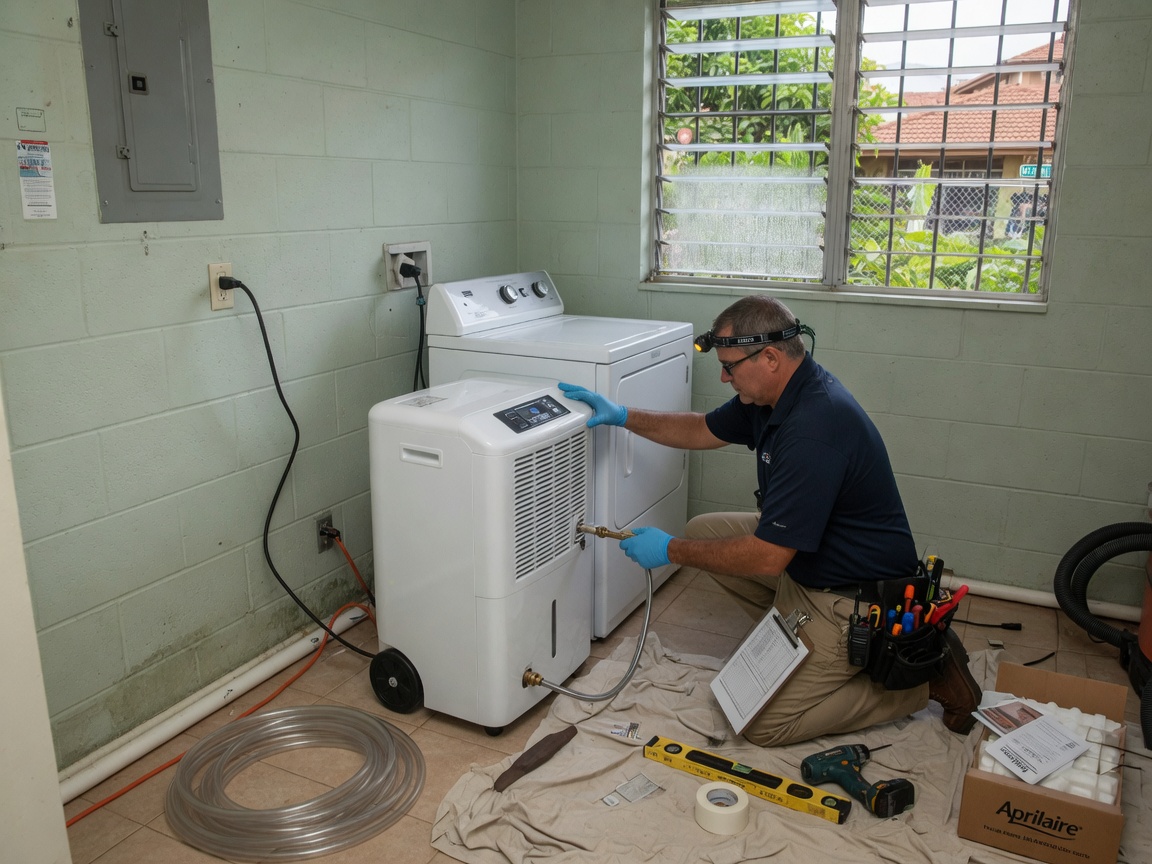
Mililani homes in Mililani Town and Mililani Mauka face persistent humidity even with trade winds, especially in single-story ranch houses built from the 1970s onward. Installing a dehumidifier requires routing condensate lines to exterior drains while accounting for the area's red volcanic soil that can shift slightly around slab foundations. We size units to match the home's square footage and existing duct layout so the system removes moisture without overcooling rooms near the Mililani Golf Club or Mililani Town Center.
In Honolulu County, building codes require proper condensate disposal and electrical disconnects within reach of the unit. Older Mililani properties often have limited attic space or R-19 insulation that lets humidity linger, so we frequently mount units in garages or utility closets and tie them into the main return plenum. Newer homes in Mililani Mauka may need variable-speed models to handle the occasional spike when trade winds drop for days at a time.
Edge cases include homes near Wahiawa or Waipahu where irrigation runoff raises indoor moisture levels. We always verify the evaporator coil condition first because a dirty AC coil in a humid climate can defeat even a correctly sized dehumidifier. Proper placement also avoids short-cycling near windows that catch afternoon sun on the leeward side of the island.
Technician insight
In Mililani the thing that catches most people out with Dehumidifier Installation is underestimating how trade winds create micro-pockets of humidity inside homes built on slab foundations in Mililani Town. Older ductwork often leaks conditioned air into the attic, so the dehumidifier ends up fighting itself unless we seal the returns first.
Persistent humidity in a Mililani Town ranch house
A 1980s single-story home near Mililani Town Center showed 65% indoor humidity despite the AC running constantly. We found disconnected duct joints in the attic allowing moist air infiltration. After installing a whole-home dehumidifier tied to the main return and sealing the leaks, humidity stabilized at 48% and the AC cycled normally.
Dehumidifier Installation Services We Offer
✓Whole-Home Dehumidifier Installation
Integrates a dedicated dehumidifier into the central AC ductwork to maintain 45-50% humidity across Mililani Mauka and Town residences without relying solely on the air conditioner.
✓Attic-Mounted Dehumidifier Systems
Places compact units in attics common to Mililani homes, with insulated lines routed to avoid condensation on rafters during trade-wind lulls.
✓Garage or Utility Closet Installations
Uses space-efficient models in garages or utility rooms typical of 1980s-1990s Mililani housing stock where attic access is limited.
✓AC System Integration
Wires the dehumidifier to run in tandem with existing AC units serving Mililani Tech Park offices and nearby single-family homes for coordinated humidity control.
✓High-Capacity Unit Placement
Installs larger units in homes near Mililani Town Center that experience elevated moisture from surrounding landscaping and irrigation.
Dehumidifier Installation Cost in Mililani, HI
| Service | Typical Range | What Affects It |
|---|---|---|
| Whole-home dehumidifier with basic integration | $1,800–$2,800 | Standard capacity unit tied into existing ducts in most Mililani single-story homes. |
| High-capacity unit for larger layouts | $2,600–$3,600 | Needed for homes with open floor plans or near irrigation-heavy areas. |
| Attic or garage mounting add-on | $400–$700 | Includes extra insulation, drain pump, and access platform if required. |
| Electrical circuit upgrade | $250–$450 | When existing panel or wiring cannot support the new load. |
Ranges are typical for Mililani, HI and confirmed with an exact written quote before any work starts.
How it works
- 1
Site Assessment
We inspect the home's duct layout, insulation levels, and existing AC in neighborhoods like Mililani Mauka or Town to determine the right unit size and placement.
- 2
Unit Selection And Placement
We choose a model suited to local humidity loads and locate it in an attic, garage, or closet while planning condensate and electrical routing.
- 3
Duct And Drain Connections
We tie the dehumidifier into the return plenum and run a gravity or pumped drain line to a safe exterior discharge point compliant with Honolulu County requirements.
- 4
Testing And Balancing
We run the system through cycles, check humidity reduction, and confirm it works with the existing AC without creating pressure imbalances.
Pricing
Cost depends on unit capacity, home size, and whether new duct runs or electrical work are required.